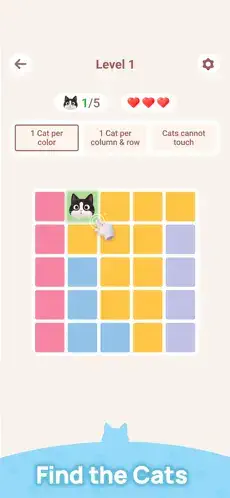
Meowdoku offers a fresh twist on classic logic puzzles. You like logic puzzles that make you think. Sudoku with its numbers. Minesweeper with its flags. Nonograms with their pictures. But you have played them all many times over.
Meowdoku is a pure deduction puzzle that rewards careful thinking. You examine the board carefully. You find where cats can legally go based on the rules. You place them one by one with confidence. Understanding the deduction rules helps you solve puzzles without guessing and losing hearts.
Meowdoku holds a 4.8 star rating on the App Store based on over 188K reviews. Size sits around 197 MB depending on downloaded assets. Age range stretches from young adults who enjoy brain teasers to older players who appreciate calm logic puzzles. If you prefer a classic number based logic puzzle without territory placement, Sudoku offers a different challenge.
What Is Meowdoku?
Meowdoku is a free to play cat themed logic puzzle from Oakever Games that blends Sudoku style placement with Minesweeper like deduction. Players must place exactly one cat in every colored region while ensuring no two cats share a row, column, or touch each other, even diagonally.
Think of it as Sudoku mixed with Minesweeper but with cute cats. Each colored region needs one cat. No two cats can share a row, column, or touch diagonally. You mark impossible spots with X and place cats with a double tap. Unlike abstract Sudoku, Meowdoku gives each placement a character, making the logic feel more personal.
Logic puzzle fans enjoy the deep deduction. Cat lovers appreciate the cute theme. Sudoku players find familiar row and column constraints. Casual gamers like the short, bite sized sessions. Anyone who enjoys deduction and spatial reasoning without math will find it engaging.
The platform is available on iOS and Android. The game is free to download with optional in-app purchases.
How Meowdoku Works
Meowdoku operates through seven interconnected systems: colored regions, row and column rules, no-touch rule, tap to mark X, double tap to place cat, hearts system, and hint system. Colored regions require exactly one cat. Each row and column must contain exactly one cat. Cats cannot touch horizontally, vertically, or diagonally. Single tap marks a cell as impossible. Double tap places a cat. Wrong placements cost hearts. Hints explain why placements are valid or invalid.
The rules are simple but strict. One cat per colored region. Every colored section must contain exactly one cat. One cat per row and column. Each row and each column must have exactly one cat, like Sudoku. No touching. Cats cannot sit next to each other horizontally, vertically, or diagonally. Three mistakes only. Wrong placements cost hearts, and you only have three chances before the level fails.
The progression loop follows a clear pattern. Study the colored regions and board size, identify small or constrained regions first, mark impossible cells with X, place a cat with a double tap only when logically certain, use row, column, region, and diagonal checks to eliminate options, clear the entire board before running out of hearts, advance to the next level.
The strategic element comes from combining all constraints simultaneously. A cell might be valid for a region but invalid because of row, column, or diagonal rules. Players must learn to eliminate options systematically.
Meowdoku Key Features
Core Gameplay
The official rules are simple but strict. One cat per colored region. Every colored section must contain exactly one cat. One cat per row and column. Each row and each column must have exactly one cat, like Sudoku. No touching. Cats cannot sit next to each other horizontally, vertically, or diagonally. Three mistakes only. Wrong placements cost hearts, and you only have three chances before the level fails.
This combination of row/column/region constraints plus a no-touch rule creates a unique puzzle genre that sits between Sudoku, N-Queens, and Minesweeper style deduction.
Difficulty and Progression
Meowdoku includes multiple difficulty levels and board sizes, ranging from small introductory grids to larger, more complex boards. The App Store reviews mention players reaching level 500 and beyond 1,000, indicating a substantial amount of content.
Progression is designed to gradually introduce more complex region shapes, larger grids, and tighter constraints. However, some long-term players report that levels start to repeat after a few hundred stages, which can reduce novelty for dedicated players.
Hints and Explanations
One praised feature is the hint system. When players use a hint, the game explains why a cat can or cannot be placed in a certain cell, rather than just revealing the answer. This educational approach helps players learn deduction patterns instead of relying on brute force hints.
This is a significant differentiator from many puzzle games where hints simply solve part of the puzzle for you. Meowdoku’s hints aim to teach logic.
Daily Streaks and Leaderboards
The game includes daily streak mechanics and a leaderboard based on fish earned from completed levels. The App Store reviews indicate that the leaderboard ranking was changed from counting cats to counting fish, which players felt made more sense.
Daily streaks encourage regular play, while the leaderboard adds a light competitive layer for players who enjoy tracking progress.
Meowdoku Graphics and Design
Meowdoku uses a clean, colorful, cat-friendly aesthetic. Boards are divided into brightly colored regions, cats are cute and expressive, and the UI is simple and readable. The design is intentionally relaxed to match the puzzle’s logic focused nature.
Visual Strengths
Clear, readable colored regions make the board easy to scan. Cute cat designs reinforce the theme and add personality. Simple, uncluttered UI reduces distraction. Smooth tap and double tap interactions feel responsive. Satisfying visual feedback for correct placements rewards progress. Relaxing color palette and gentle animations create a calm atmosphere. Accessible design suitable for all ages lowers the barrier to entry.
The cat theme is central to the game’s identity. Unlike abstract Sudoku or N-Queens puzzles, Meowdoku gives each placement a character, which makes the logic feel more personal and engaging.
Design Weaknesses
The biggest design criticisms are not about art quality but about monetization and feature changes. Excessive ads after every level interrupt flow. Long or difficult-to-close ads frustrate players. Removal of draft mode and undo button reduces flexibility. Perceived push toward ad-based hints instead of free tools pressures spending.
Another player complained that the undo and draft features were removed to encourage ad views for hints, although the developer responded that these features are undergoing testing and adjustments, not removed to force ads.
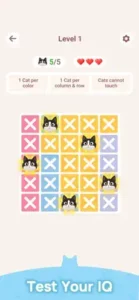
Meowdoku Tips To Improve Your Logic
Starting with Meowdoku feels simple. You place cats, mark X’s, and clear boards. But most players hit walls where puzzles become tricky and hearts run low. Here is how experienced players solve puzzles efficiently.
Start with the smallest regions. Small or oddly shaped regions often have only one or two possible cat positions. Solving these first reduces complexity elsewhere. Small regions give you the most information. A region with two cells tells you more than a region with ten.
Mark impossible cells early. Use X marks to eliminate cells blocked by existing cats, shared rows, columns, or diagonal contact. This visual elimination helps prevent mistakes. X marks keep you honest. The more X’s you place, the clearer the solution becomes.
Use rows and columns as checkpoints. Once a row or column has a cat, every other cell in that line is ruled out. Treat completed lines as dead space. Completed lines simplify the board. A solved row removes multiple possibilities at once.
Check all eight neighbors. Before placing a cat, confirm that no existing cat touches it horizontally, vertically, or diagonally. A cat blocks all eight surrounding cells. Diagonal contact is easy to miss. Always check corners.
Place only when logically certain. Avoid guessing. A correct move should be backed by elimination, not intuition. Wrong taps cost hearts, so patience is essential. Certainty beats guessing. If you are not sure, mark X and come back later.
Scan diagonals carefully. Diagonal contact is easy to miss. Always check corner neighbors, not just horizontal and vertical neighbors. Diagonals are the most common mistake. A cat one row up and one column over still touches.
Use hints strategically. Hints are most valuable when you are genuinely stuck. Use them to learn deduction patterns rather than as a crutch for every puzzle. Hints teach you logic. Pay attention to the explanation, not just the answer.
Manage your hearts. Do not waste hearts on speculative placements. If you are unsure, mark cells with X and revisit them after solving other regions. Hearts are precious. Three mistakes end the level.
Play daily for streaks. Daily streaks provide motivation and potentially extra rewards. Even short sessions can maintain your streak. Consistency pays off. A few minutes each day keeps your skills sharp.
Accept that some levels repeat. Long-term players report level repetition after a few hundred stages. Treat repeated levels as practice rather than new challenges. Repetition builds skill. Use repeated levels to refine your technique.
Be cautious with ads. Some players report scam-like ads. Do not click on suspicious pop-ups, especially those claiming viruses or urgent downloads. Safety first. If an ad seems dangerous, close it immediately.
Use feedback channels. If you encounter ad or feature issues, use the in-app Settings – Feedback option to report problems. The developer has responded to reviews and indicated willingness to investigate. Feedback helps improve the game. Your voice matters.
Meowdoku Similar Games
Meowdoku offers unique region based logic, but it is not the only puzzle game. Here is how it compares to other popular options.
| Game | Best For | Main Difference from Meowdoku |
|---|---|---|
| Sudoku | Classic number placement logic | Uses numbers 1–9 without colored regions or no-touch rules |
| N-Queens puzzle | Pure no-touch placement | Focuses only on no-touch constraints without colored regions |
| Nonogram | Picture based logic puzzles | Uses number clues to fill grids, not region placement |
| Capybara Doku | Cat themed sibling puzzle | Reuses Meowdoku components with a capybara theme |
| Queens (logic puzzle) | Region based no-touch placement | Similar rules but often without the cat theme or hearts system |
| Logic Pic / Pixel Puzzles | Picture reveal logic | Uses color/number clues to reveal images, not cat placement |
| Blockudoku | Block placement puzzle | Uses falling blocks and line clearing, not region logic |
| Minesweeper | Deduction and risk management | Uses number clues and hidden mines, not colored regions |
| Sudoku Quest | Story driven Sudoku | Adds narrative but keeps classic Sudoku rules |
| Cat Sudoku | Cat themed Sudoku variant | Uses cats instead of numbers but lacks no-touch and region rules |
Which one wins? It depends on your preferences. The Meowdoku game wins on cat themed logic and region based deduction. Sudoku wins on classic number placement. N-Queens wins on pure no-touch constraints. Nonogram wins on picture reveal logic. Capybara Doku offers a similar experience with a different animal theme for players who want variety without losing the core mechanics.
What Players Say About Meowdoku Game
What Players Appreciate
Players enjoy relaxing, logic-based gameplay. Cute cat theme and colorful regions add charm. Satisfying deduction without guessing rewards careful thinking. Educational hint system that explains logic teaches patterns. Short, bite-sized puzzle sessions fit busy schedules. Daily streaks and leaderboard progression provide motivation. Accessible rules suitable for all ages lower the barrier.
What Players Complain About
Too many ads, often after every level, interrupt flow. Long or unskippable ads that are hard to close frustrate players. Removal of draft mode and undo button reduces flexibility. Perceived shift toward ad-based hints pressures spending. Lack of real customer support leaves players without help. Level repetition after a few hundred stages reduces novelty. Frustration with heart system limiting experimentation discourages learning.
Conclusion
Meowdoku is a charming and intellectually satisfying logic puzzle that successfully blends Sudoku style placement, N-Queens no-touch constraints, and Minesweeper like deduction into a cohesive cat-themed experience. Its rules are simple, its puzzles are deep, and its hint system teaches rather than solves.
Its greatest strength is unique logic with cat-themed charm. Its main weakness is that charm comes with ad interruptions. The game is free, but many players report excessive ads, removal of draft/undo features, and occasional scam-like advertisements. If you can tolerate frequent ads or find a legitimate ad-free purchase, the underlying puzzle experience is excellent.
Meowdoku fits logic puzzle fans, cat lovers, Sudoku players, casual gamers, and anyone who enjoys deduction and spatial reasoning without math. It does not fit players who dislike frequent ads. It does not fit players who want a true ad-free experience. It does not fit players who prefer competitive or social puzzle games.
Meowdoku gives you a relaxing and satisfying logic puzzle with cute cats and educational hints. But relaxation comes with interruptions. You deduce, place, and progress. The result is a game that rewards careful thinking but tests your tolerance for ads.
You have probably played logic puzzles that felt abstract or repetitive. What if the solution was not more numbers, but cute cats and satisfying deduction? Meowdoku solves that by offering region based logic with personality. But the solution only works if you can tolerate the ads. The question is not whether Meowdoku works. The question is whether you are ready to deduce through the interruptions.
FAQ
Is Meowdoku free to play, and where can I download it?
Yes, Meowdoku is free. You can download Meowdoku from the Official App Store. No subscription walls. Just logic puzzles with cats.
How do the rules work with cats per color, per row, and not touching?
Think of it as Sudoku but friendlier. Each color appears once per row and per column. Same color cats cannot touch each other, not even diagonally. The puzzles start easy at Level 1, then quietly get harder. You will feel smart, then humbled, then smart again.
Where can I read the full game rules or check the developer updates?
Visit the official website: Official Meowduku Website.
I found a bug or have a suggestion. Who do I contact?
Visit the official website: and go to contact page.
Does Meowduku actually test your IQ, or is that just marketing?
The “Test Your IQ” label on Level 1 is a warmup. The real test is whether you can finish Level 5 without guessing. Some puzzles force you to hold two or three logical constraints in your head at once. That is not an IQ score, but it is real thinking. So try it. Then ask yourself: did that feel easy, or did it feel like a workout?