
Letterpress: The Word Game That Plays Like Chess and Reads Like Poetry

Letterpress is a minimalist, turn based word strategy game where two players spell words on a 5×5 grid of 25 letters to capture the most tiles. Created by Loren Brichter of Atebits and now maintained by Solebon LLC, it blends vocabulary with territorial control in a way that no other word game attempts. The game holds a 4.7 star rating across roughly 8,200 reviews on the App Store. The file size sits around 50 MB on iOS. The age rating is 4+ on the App Store.
Player sentiment leans positive. Fans celebrate the elegant strategic twist on word games. Critics point to intrusive ads in the free version and dictionary inconsistencies that sometimes allow obscure words while rejecting valid ones.
When Word Games Stop Being About Words Alone
What Letterpress Promises
Most word games reward vocabulary size. Letterpress rewards something else entirely. Territory. Timing. The ability to see three moves ahead while your opponent sees one.
The pitch works because Loren Brichter built his reputation on clarity and precision. As the creator of Tweetie, the Twitter client Apple eventually acquired, Brichter understood how to strip software down to its essentials. Letterpress applies that philosophy to word games. No clutter. No point counting. No premium squares with confusing multipliers. Just 25 letters, two players and a battle for the board.
What Actually Lands
The territory mechanic is the strongest argument for downloading Letterpress. Spell a word and tiles flip to your color. Surround your tiles and they lock, preventing recapture. That single rule transforms a vocabulary test into a spatial strategy game.
Games end when all 25 tiles are claimed or both players pass. Highest tile count wins. Simple to understand. Deep to play. The comparison players keep making is chess meets Scrabble and that is not marketing. It is accurate.
The design deserves its reputation. Letterpress won the 2013 Apple Design Award and was featured in the App Store’s Best of 2012 list, ranking second place as iPhone Game of the Year. The interface is intentionally barren, with smooth tile flips and clear color-coded feedback. The app weighs almost nothing and loads instantly.
What Creates Friction
The dictionary remains the loudest complaint. Letterpress uses multiple dictionary sources for validation, which creates inconsistency. Players report valid words being rejected while obscure foreign terms are allowed. The Lexibot opponent sometimes permits words that players cannot use and vice versa.
Ads in the free version frustrate some users. One player described 2 to 3 second freezes and occasional 30 second video interruptions that cannot be clicked out of. The one time upgrade costs around $9.99 and removes ads entirely. It is not required to play. It is required to play without friction.
What Letterpress Actually Does Differently (And Where It Falters)
The Territory Mechanic That Changes Everything
Spell a word. Tiles flip to your color. That is the foundation. Lock tiles by surrounding them. Locked tiles cannot be recaptured. This single rule transforms a vocabulary test into a spatial strategy game.
The depth comes from the tension between word length and board control. Longer words capture more tiles, but they also leave openings your opponent can exploit. Shorter words let you claim key positions and lock them down efficiently. Knowing when to go big and when to play small is the skill that separates good players from great ones.
The game ends when all 25 tiles are claimed or both players pass. Highest tile count wins. The match length varies wildly depending on opponent behavior. Some games resolve in minutes. Others stretch across days through asynchronous play.
Opponents, Chat and the Social Layer
Letterpress supports three opponent types. Friends, random matchmaking, and AI bots. Single player mode replaces the opponent with Lexibot. The bot plays reasonably well, though players report occasional quirks where it uses locked tiles or plays words that should not validate.
Real time chat lets you talk during matches. Turn notifications keep asynchronous games moving. You do not need to sit and wait. Leaderboards and statistics track your performance over time.
The social layer works best when you have a consistent opponent. Many players report long running rivalries with friends or family members, sometimes spanning years of casual matches.
The Dictionary Problem Nobody Talks About
Letterpress uses multiple dictionary sources for validation. That creates inconsistency. Players report valid words being rejected while obscure foreign terms are allowed. The Lexibot dictionary sometimes permits words that players cannot use and vice versa.
This frustrates some users. Others learn to adapt. The lexicon is part of the game’s personality, whether you like it or not. If you play enough, you develop a sense of which words pass and which fail. It is not perfect. It is rarely a dealbreaker for players who enjoy the strategic core.
Ads and the Upgrade Decision
The free version includes ads. Some players describe them as intrusive, with 2 to 3 second freezes and occasional 30 second video interruptions. The one time upgrade costs around $9.99 and removes ads entirely.
The upgrade is not required to play. It is required to play without friction. If you enjoy the game, the upgrade pays for itself in sanity. The developer has kept the game updated for over a decade, which is rare in mobile gaming.
Design That Gets Out of the Way
Letterpress uses a clean, minimal aesthetic. The 5×5 grid is the interface. Color coded tiles show territory at a glance. Smooth tile flips and clear lock indicators provide immediate feedback. The design was polished enough that it was used as inspiration for Apple’s iOS 7 redesign.
The app weighs around 50 MB on iOS. It loads fast. It does not demand storage space or processing power. It runs on Mac, iPhone, iPad and Android.
Some players want new theme color schemes. The design has remained consistent, which is both a strength and a limitation depending on your perspective. The simplicity is the point. It has aged well because it never chased trends.
Letterpress Tips
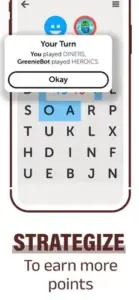
You do not need to be a spelling bee champion to win at Letterpress Game matches. The players who climb leaderboards understand something simple. Territory matters more than vocabulary. Here is how to think about the board.
Control the center early. Central tiles connect to more potential words than edge tiles. Claiming them gives you more options on every subsequent turn while limiting what your opponent can build. The player who owns the middle usually owns the match.
Plan two moves ahead. Every word you play leaves letters exposed. Ask yourself what your opponent can do with the tiles you are not protecting. Avoid leaving open paths they can use to recapture your territory. This single habit separates casual players from consistent winners.
Use short words strategically. Long words feel satisfying. They also flip more tiles at once, which means they are harder to defend. Save your biggest words for critical turns when you need to swing the board. Short words claim key positions without overextending your defenses.
Lock clusters, not strays. Isolated tiles are easy to recapture. Focus on surrounding groups of tiles to secure them permanently. A locked cluster becomes a fortress. A single locked tile is just a temporary obstacle.
Learn the lexicon. Letterpress uses multiple dictionary sources, which means some obscure or foreign words may be valid while common words are rejected. Pay attention to what passes and what fails. The lexicon is part of the game’s personality, whether you like it or not. Adaptation makes you harder to beat.
Use the built-in dictionaries mid-game. The game includes real-time definitions. Looking up a word before you play it confirms validity and expands your vocabulary over time. It is a small habit that pays off across dozens of matches.
Upgrade to remove ads if interruptions disrupt your flow. The free version works. The one-time upgrade removes ads and lets you focus on the board instead of waiting through interruptions. If you play regularly, it is worth considering.
Letterpress Similar Games
| Game | Best For | Main Difference from Letterpress |
|---|---|---|
| Words With Friends 2 | Social async word battles | 15×15 board, point scoring, no territory locking |
| Scrabble GO | Official Scrabble on mobile | Classic tile laying, premium squares, no capture mechanic |
| Wordfeud | Minimalist async word board | 15×15 board, random bonus squares, no locking |
| SpellTower | Solo word puzzle survival | Falling tiles, clear lines, single player focus |
| Word Streak | Fast 4×4 word finding | Timed rounds, no territory control |
| Wordle clones | Daily word puzzles | Single player deduction, no multiplayer board |
Letterpress sits in the strategic middle ground. It offers more depth than casual word finders. It remains more accessible than tournament Scrabble. It feels more intellectual than social word games built around point totals. The key differentiator is simple. No other mainstream word game uses territory capture and tile locking as core mechanics. That mechanical identity is why Letterpress has survived for over a decade while other word games faded.
Unlike many mobile games, Letterpress codes do not exist in the traditional sense. There are no redemption codes or promotional unlocks. The game operates on a straightforward model. Download it, play it, upgrade once if you want to remove ads. That simplicity is part of its appeal.
Frequently Asked Questions About Letterpress
Where can I find the official Letterpress download links?
The Letterpress game is available on the App Store for iPhone and iPad. For desktop players, Letterpress also runs on Mac. The official website for Solebon LLC serves as the central hub for platform links and announcements.
How do I contact Letterpress support if I run into bugs or account problems?
The developer, Solebon LLC, handles player support through email at solebonapps@gmail.com. You can also reach the support team through the app store listing pages, which include a direct support contact option. For community updates and patch notes, the official Solebon website posts regular announcements.
Is Letterpress the same game across iOS, Android and Mac?
Yes, the core experience remains consistent across platforms. The 5×5 grid, territory capture mechanic and Lexibot opponent work the same way regardless of device. Cross platform play connects iOS, Android and Mac users in the same matchmaking pool.
What makes Letterpress different from other word games?
The territory capture mechanic. Spelling words claims tiles and surrounding them locks them permanently. No other mainstream word game uses this system. It transforms vocabulary into spatial strategy, creating depth that pure word finding games cannot match.